
















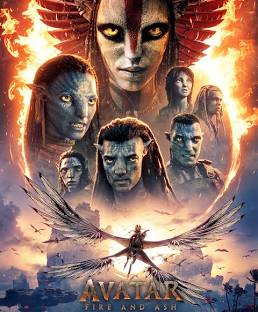
Three years after Avatar: The Way of Water was released came the third installment of the series, Avatar: Fire and Ash. This movie came out in theaters on December 19, 2025, and has already made over $1 billion in revenue in the box office, almost reaching the same prestige and hype as its predecessor.
The movie follows the Sully family, who have to deal with the loss and grief of their son, Neteyam whilst preparing against the everlooming threat of the RDA and General Quaritch. The RDA is the Resources Development Administration, and they were a major antagonist in the first Avatar movie, as they wish to colonize the Na’vi people for the natural resources that their land has.
General Quaritch has been a main villain within the movies ever since his appearance in the first film, and has grown to become an even bigger formidable force. In the second film, his memories and consciousness were backed up onto a ‘drive’ and that data was used by the RDA to put within a genetically engineered Na’vi human body. We learn that he gets saved in Avatar: The Way of Water by his son, Spider, the adopted son of Jake and Neytiri Sully.
Furthermore, there is a new Na’vi tribe called the Ash People (known as the Mangkwan Clan), and they team up with General Quaritch. The Ash People are led by a Na’vi woman known as Varang. Throughout the movie, the directors emphasize a newfound relationship between General Quaritch and Varang, which challenges his ideals on the Na’vi people and his life as an avatar.
Varang deeply despises those who are spiritually aligned with Eywa because she believes that Eywa abandoned her and her village during a time of a volcanic eruption when she was a little girl. Eywa is called the “Great Mother” and she is essentially the conscience of every living being in Pandora, where the Na’vi are native to. The Na’vi believe that Eywa is the creator of all living things and that she is the management of the Pandora ecosystem.
Straight from the beginning, the aspect of Avatar: Fire and Ash that caught my attention the most were the visual effects and compelling narration by Lo’ak (the son of Jake Sully). The imagery and sound are unbelievably beautiful, especially the vivid scenes of the fights between the Na’vi people, and how elegantly the Na’vi connect with Eywa.
One such example is the scene where we first see the Varang clan introduced. Straight from the beginning, we notice the details of fire and ash truly becoming a part of this movie. With explosions and the sound effects echoing throughout the room where the movie was playing, I felt that this brought an extremely hostile atmosphere and it made the audience already on the edge of their seats and in fear of what was to come.
Alongside the visual effects, the narration by Jake Sully’s son, Lo’ak is a breath of fresh air, since the last two movies were narrated by Jake Sully. His narration shows us his point of view on his father which is unlike the other movies, and the complex relationship dynamics between both Na’vi men. Lo’ak’s narration also gives us a deeper understanding of how the Sully family began to cope after the death of Neteyam.
Apart from these visual effects, I personally felt that much of the movie’s storyline was a copy and paste of the second movie. There’s a recurring theme that seems to be happening as the movies progress over the years, with General Quaritch repeatedly serving as a looming villain and there always being a threat coming for Jake Sully due to his ‘disobedience against orders’ in the first movie.
To continue, the movie in its entirety was a bit too rushed, and it seemed as if the directors were cramming in details that were irrelevant later on in the rest of the movie. For example, the introduction of the Wind Traders (Tlalim Clan), as a nomadic group of Na’vi was very interesting as it showed the audience other kinds of clans apart from what we’ve learned about in both movies. However, this was ruined because as soon as they were introduced, they were taken out and never seen again, with only about 5-10 minutes of screen time.
To go back to the Ash People and their crazy leader, Varang, their entire presence is a new revelation of what the Na’vi can become. In a few minutes after the Tlalim Clan were introduced, the Ash People were also introduced, but by attacking them. This is the first time that we, as an audience, see a hostile group of Na’vi who attack other Na’vi, which hasn’t been done before that movie. I felt that this scene was quite pivotal, as it demonstrated the heartlessness and craziness of the clan and what they would do to extort their power.
Throughout the franchise, the movies’ main plots have always been the humans versus the Na’vi, with humans typically being seen as the enemy or invasive to the Na’vi way of life. But in spite of this, this movie explores the notion that not everyone in a specific race is evil or good, as we see when a human ends up becoming the one to rescue Jake Sully when he is trapped by the RDA and nearly sent to execution.
Personally, this movie was not my favorite and I don’t really think that it was as good as the other movies in the installment. Despite this, I am excited to see the fourth movie in this long-awaited series.